Key Takeaways
- Manufacturing resource planning (MRP II) separates material and capacity planning by design. This sequential logic worked in stable environments but cannot handle today’s volatile, interconnected production reality.
- Plans that look correct in enterprise resource planning (ERP) are often not feasible on the shop floor. Material availability does not equal machine availability, and missing dependencies make theoretically sound plans practically impossible.
- Batch-based planning creates decision latency. When shop floor disruptions reach the plan with a delay, the time between a problem occurring and the ability to respond becomes a structural competitive disadvantage.
- Excel and planner experience are not a solution. They are a workaround that masks the structural gap. As complexity grows, they stop working.
- Constraint-based, simultaneous planning is the answer. Advanced Planning and Scheduling synchronizes materials and resources in one integrated model, turning planning from a reactive report into an active control instrument.
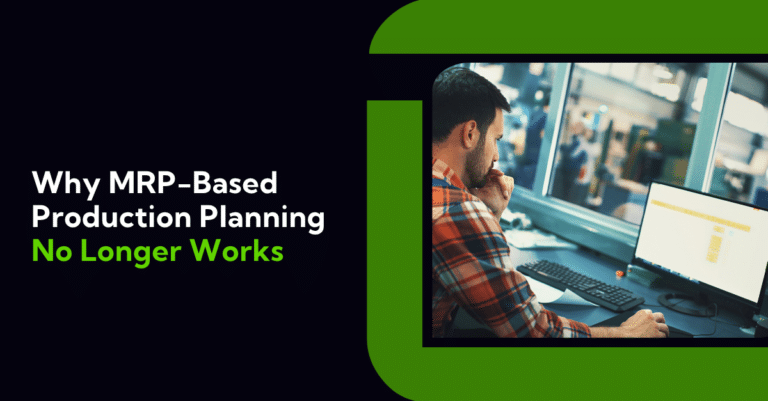
Why MRP-Based Production Planning No Longer Works
Complexity has always been part of manufacturing. But what used to be manageable is now volatile, disconnected, and increasingly difficult to control with traditional approaches. The critical difference is not the number of problems, but the speed at which they occur–and that’s precisely where traditional ERP reaches its structural limits.
Complexity Has Always Been There, But Today It Is Different
Production planning has never been simple. Anyone familiar with manufacturing environments knows there have always been bottlenecks, material issues, and short-notice order changes. Planners learned to handle them through experience, intuition, and a good sense of priorities.
But the underlying conditions have changed fundamentally. Fluctuating order volumes, shorter lead times, restricted material availability, and a growing number of product variants define the daily reality of manufacturing companies today. At the same time, expectations around delivery reliability, transparency, and cost efficiency continue to rise.
The result is that complexity is no longer something an experienced planner can manage through intuition alone. It has become structural, so it demands structural answers. Traditional ERP-based planning is no longer providing reliable answers.
How Traditional ERP Works, and Why It No Longer Holds Up
ERP systems operating on MRP II principles follow a clear logic: Material requirements are calculated, and then capacity is checked. Both steps happen separately and sequentially rather than simultaneously.
In practice, this means that what is needed gets planned for first. Then, the system checks if the capacity is sufficient. If not, manual rework begins. There is no true synchronization between material requirements and machine availability, setup times, tooling, or sequence dependencies.
On top of that, many planning processes run as batch jobs within ERP. They deliver results at fixed points in time, but provide no interactive, real-time decision support. What the system shows often reflects a snapshot that is already outdated by the time the plan is executed.
The Structural Problem: The Plan Looks Correct, But It Is Not
The real problem with traditional ERP-based planning does not lie on the surface. The numbers add up, the dates are entered, and the orders are scheduled. From a system perspective, everything looks fine.
But in reality, critical connections are missing. Material availability does not necessarily line up with machine availability. Free capacity does not necessarily mean that a setup-optimized sequence is possible. And even when both seem to be in place, tool availability, staffing, or sequence dependencies can make the plan impossible to execute in practice.
This results in plans that are theoretically correct but not feasible operationally. The shop floor is the first to notice, often only after the order has already entered production.
The Reality on the Shop Floor: Excel, Experience, and Constant Rescheduling
Anyone running production scheduling today knows how it goes. Alongside the ERP system, there is a spreadsheet. Planners use it to capture what the system cannot represent, such as sequences, priorities, and exceptions. Decisions are based on experience, not system-supported analysis.
When something changes, whether it’s a machine breakdown, a material delay, or an urgent customer order, manual rescheduling begins. Orders get shifted, priorities reset, and agreements are made. Planning is reactive, and the planner becomes a firefighter.
This is not a failure of the people. It is the result of a system that was never designed for this kind of dynamic.
Why This No Longer Works: Decision Latency as a Structural Risk
In stable environments, this approach was acceptable for a long time. The reaction window was typically wide enough to intervene manually before problems escalated. But that buffer no longer exists.
When changes on the shop floor—such as machine failures, quality deviations, or material shortages—are only reflected in the plan with a delay, structural decision latency (time between a disruption occurring and the ability to respond)emerges. In an environment with tight delivery windows and high order density, that latency becomes a competitive disadvantage.
Planning that reacts rather than anticipates cannot sustain operational excellence over time. The more dynamic the production environment, the more apparent it becomes that transaction-based planning is no longer sufficient.
What You Need: Integrated, Constraint-Based Planning
The way out of this structural dilemma is not more Excel spreadsheets or manual intervention. It is a fundamentally different planning approach: simultaneous, constraint-based planning.
Advanced Planning and Scheduling (APS) solutions synchronize materials and resources in an integrated mode simultaneously. Setup times, tool availability, machine capacities, and material flows are considered together—so plans become operationally executable.
Over time, APS enables your business to transform the function of planning from a passive reporting process into an active decision-making instrument. That way, you can respond to disruptions in real time and reduce decision latency.
In the next post, we’ll walk through why your production plan looks perfect in ERP, but fails on the shop floor.
If you’re ready to learn more about our APS software and what it can do for your business, feel free to contact us or request your personalized demo.